Chroniqueur
ROLE
UX Engineer
YEARS
2020 - 2023
DURATION
32 months
PROBLEM
Emergent narratives are a main appeal of emergent games, but they are often obfuscated by the complex systems required in order to generate them
- One of the main appeals of emergent narrative games is the stories they can generate.
- Emergent narratives are not stories written by someone beforehand but rather narratives that users conceive as the experience unfolds.
- However, these games tend to be complex simulations, resulting in a large amount of information that makes the discoverability of stories challenging.
SOLUTION
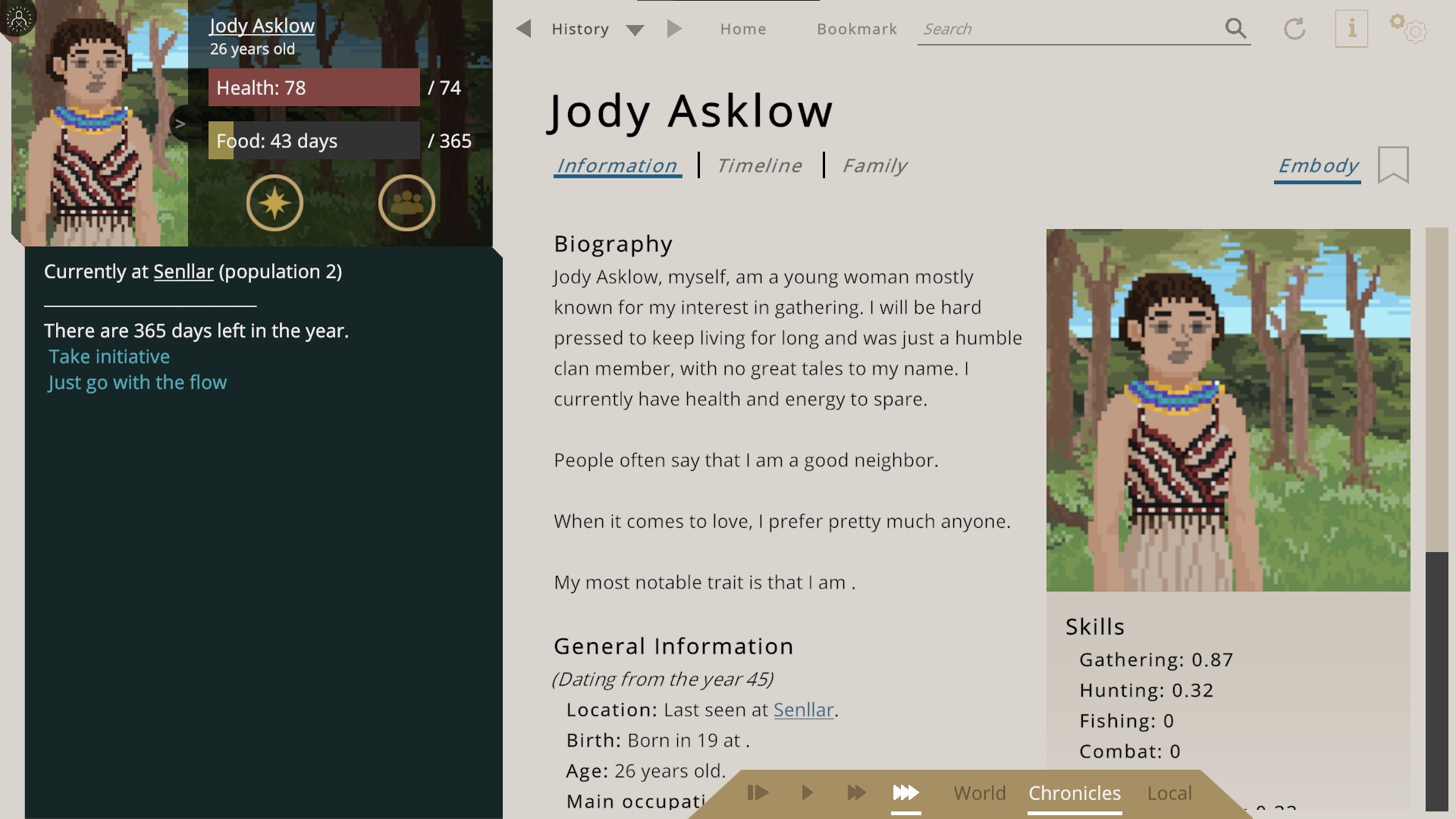
An interface that can help even inexperienced players navigate easily a large mass of information in the game
- Chroniqueur’s interface was inspired by Dwarf Fortress Legends Mode, Diol/Diel/Dial (Ryan 2018) and Wikipedia, 3 interfaces that utilize many elements of Web navigation.
- Web interfaces were the starting point for 2 reasons, the first being that Internet is the ecosystem with too much information which requires a special kind of navigation to make it usable.
- The second reason was that by simulating an experience and interface similar to one that most people are familiar with, even inexperienced players would feel more comfortable navigating our game.
OUTCOME
Participants felt that the interface was intuitive and their actions proved this; they had no issue navigating the interface.
They mentioned how the interface reminded them of a Web page which shows that the inspiration was not lost on them.
The visual elements of the interface influence the way participants interact with the game.
1. Research
CONTEXT
Chroniqueur is the foundation of my research project, my goal was to create an interface that would facilitate the discoverability of emergent narratives in a complex simulation game
- This research takes place within the larger context of the Chroniqueur project, which aims to explore design strategies to emphasize the experience of emergent narratives in accessible ways.
- This represents a vast undertaking that goes beyond the scope of a single MDes project. It provides, however, a context in which more focused research can happen.
- This research addresses a specific aspect of Chroniqueur’s problem-space: making emergent narratives easier to discover. Although I helped with narrative elements and gameplay design, my focus was to design an interface that would: foster curiosity, lower barriers of entry and facilitate discoverability of emergent narratives.
EMERGENT NARRATIVES
In the context of a video game, players' actions in a game can result in the creation of events. These events are the emergent narrative, the game's narrative elements born out of the player's actions
- Narratives are a key aspect of engagement in video games. They can ease players into the game and keep them engage until they reach an end.
- However, video games possess more than one type of storytelling. One of these storytelling methods is named emergent narratives.
- Emergent narratives are not stories written by someone beforehand but rather narratives that users conceive as the experience unfolds (Jenkins 2004, 13) (Kreminski and Wardrip-Fruin 2019, 3).
2. Chronicles V1
CHRONICLES
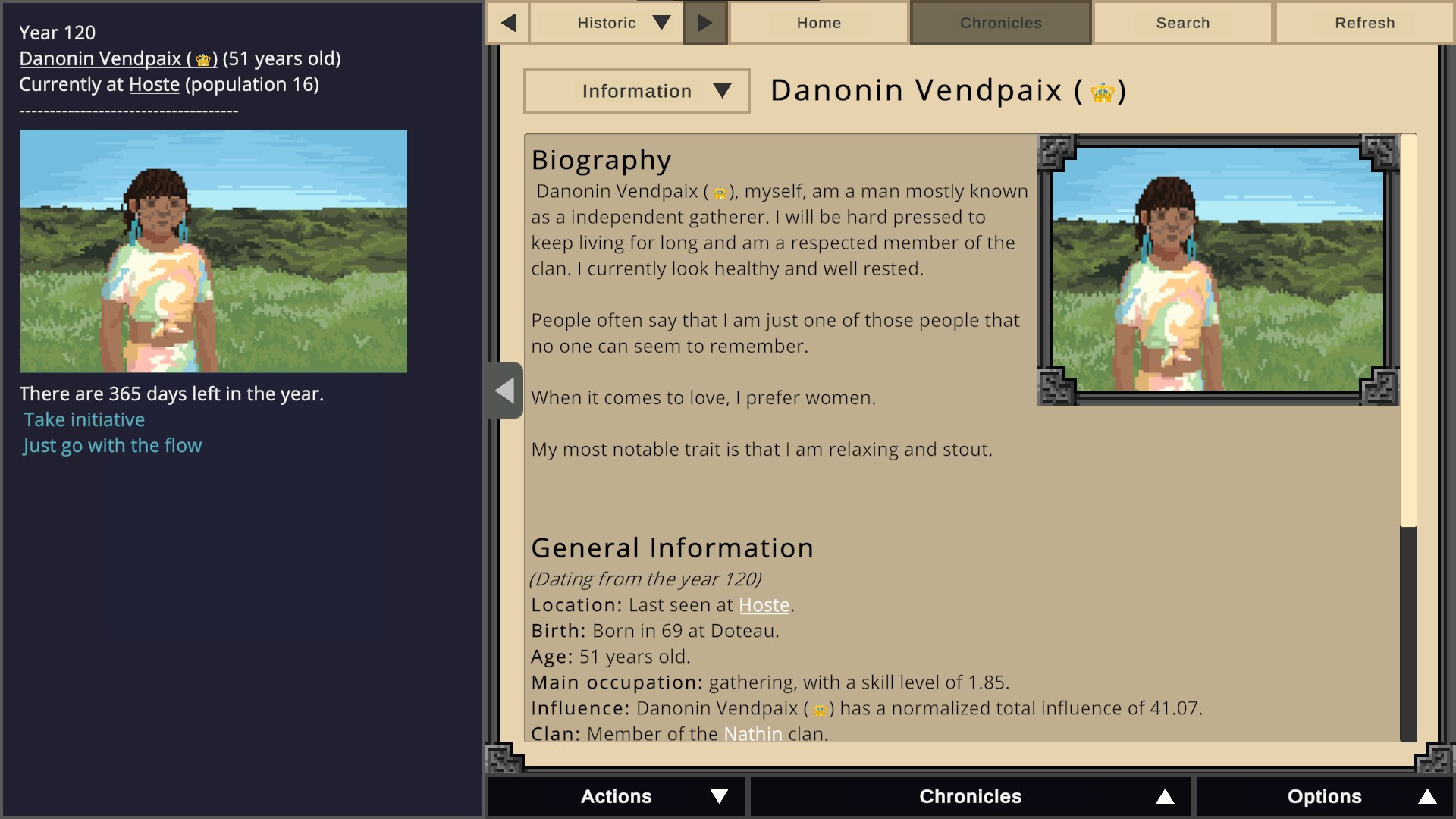
Chronicles, this is what we call the interface that serves as an encyclopedia of what was and what will be for every game of Chroniqueur
- Chronicles is the section in the user interface that allows players to read the information written about the world generated by the simulation in Chroniqueur.
- Every new game creates a new world with its unique history, meaning that the Chronicles must adapt its layout to the simulation-generated information.
- Couple this situation with the goal of documenting every piece of information present in the game, and the Chronicles become a challenging interface to design.
INSPIRATION
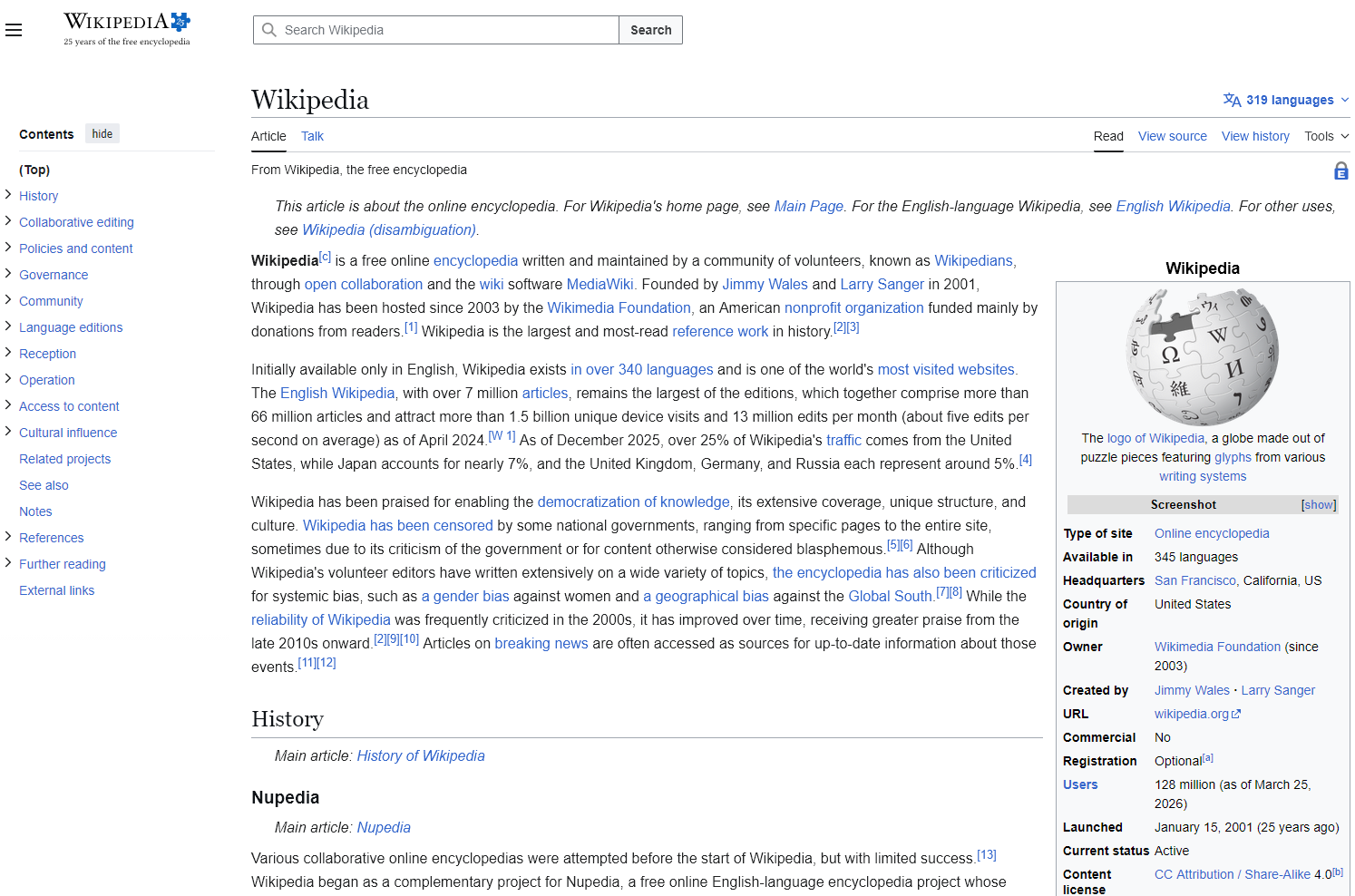
Chronicles draw inspiration from 3 projects; Dwarf Fortress and Diol/Diel/Dial which are video games with emergent narratives and Wikipedia the free encyclopedia
Dwarf Fortress
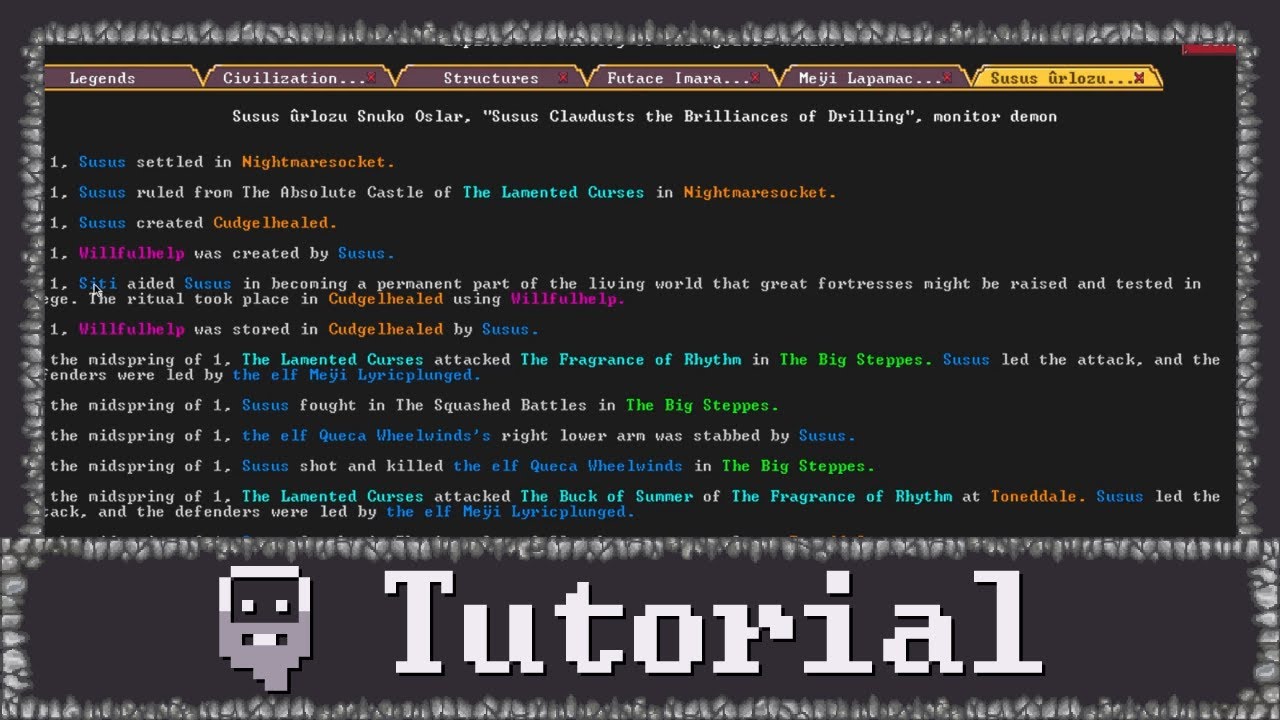
Dwarf Fortress Legends is a game mode allowing players to generate a world and read about it instead of impersonating a character or managing a fortress. This approach was a major source of inspiration since it avoids a problem previously mentioned where games are far too challenging to learn and play, which deters some players.
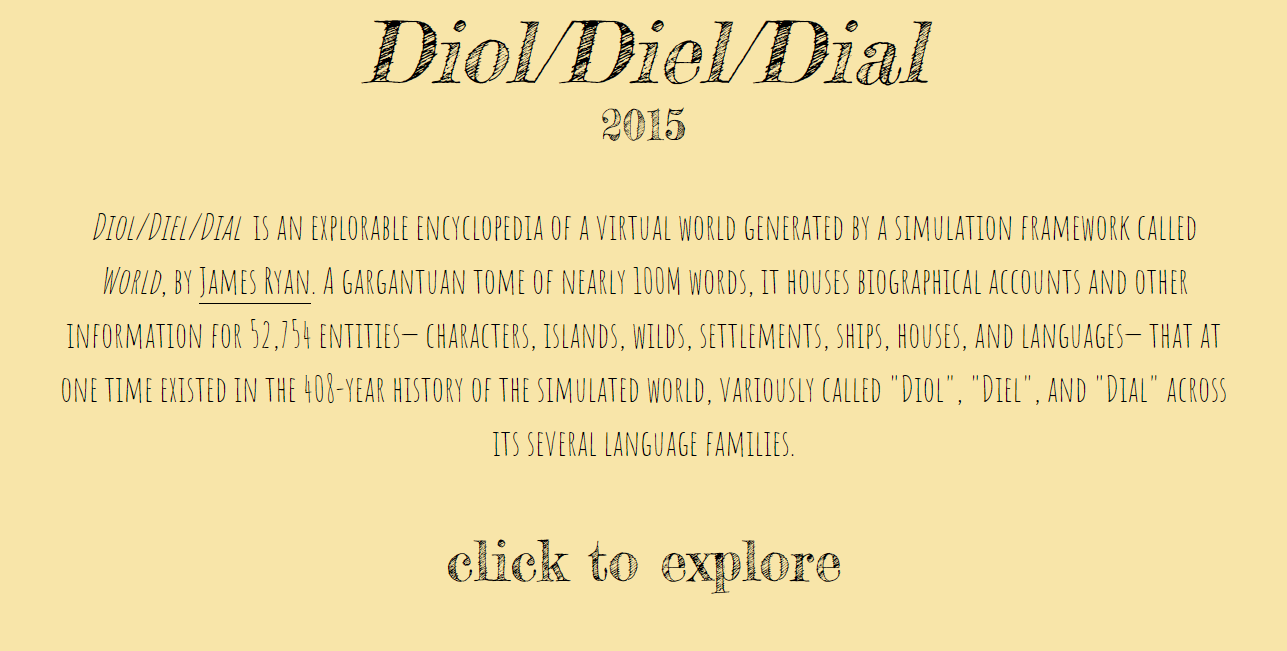
Diol/Diel/Dial
Diol/Diel/Dial is a story generator that James Ryan developed for his research on Curating Simulated Storyworlds (Ryan 2018, 296). It is essentially a web page containing all the information about a simulated world. Players can navigate information about a world and discover stories generated by the game by using clickable links to access pages, just like a web page.
Image source:
Diol/Diel/Dial
Wikipedia
Wikipedia is possibly one of the most extensive collections of knowledge online and every subject has its own page with subsections allowing for an efficient navigation of it. Our speculations was that users would have an easier time transferring their habits from one medium to another and, therefore, find it far less daunting to play what would otherwise be a complex game.
Image source:
Wikipedia
3. Chronicles V1 Evaluation
PLAYTESTS 1
Playtests were conducted with participants to evaluate the Chronicles’ navigation and assess its strengths and pain points
- Playtest sessions were planned to evaluate the reception of the Chronicles. These playtests asked participants to accomplish a list of tasks in Chroniqueur over a period of 30 minutes; during that session, I would take notes about their behaviour and answer any questions they might have.
- Once participants were done with the playtest, they would take part in a semi-formal interview, allowing me to discuss with them and get their first-hand experience.
- In the end, the playtest sessions yielded qualitative data, which helped us understand the pros and cons of Chroniqueur and its Chronicles.

PLAYTESTS 1 LEARNINGS
The reception of Chronicles V1 is that the interaction affordances are clear, but navigation is unintuitive, and features feel hidden
GOOD
Clear interaction affordances
Clickable links were immediately understandable and usable by all participants, requiring no assistance and clearly signaling interactivity.
AMBIGUOUS
Learnable but not intuitive interface
Most participants found the interface acceptable after guidance or familiarization, suggesting learnability but weak initial usability.
MISSING
Lack of navigation aids
Requests for bookmarks, tabs, and overview pages indicate difficulty tracking, returning to, or organizing information.
BAD
Poor discoverability and navigation
Key features, pages, and tabs were hard to find, sometimes hidden behind dropdowns or unclear groupings, leading to frustration.
4. Chronicles V2
FIXING MAJOR ISSUES
There is value in inspiration, but the desire to diverge can inadvertently dismantle its original strength
- The navigation of the Chronicles was one of the most significant problems to solve.
- The idea was to take inspirations from web browsing, but the differences proved to be detrimental to players’ experience.
- Consistency and standards are Nielsen’s fourth heuristic principle for a reason (Nielsen 2005, 4).
CHANGES
The changes from Chronicles V1 to V2 were numerous, but boils down to 3 key revisions: a refined navigation bar, new features, and a refreshed aesthetic
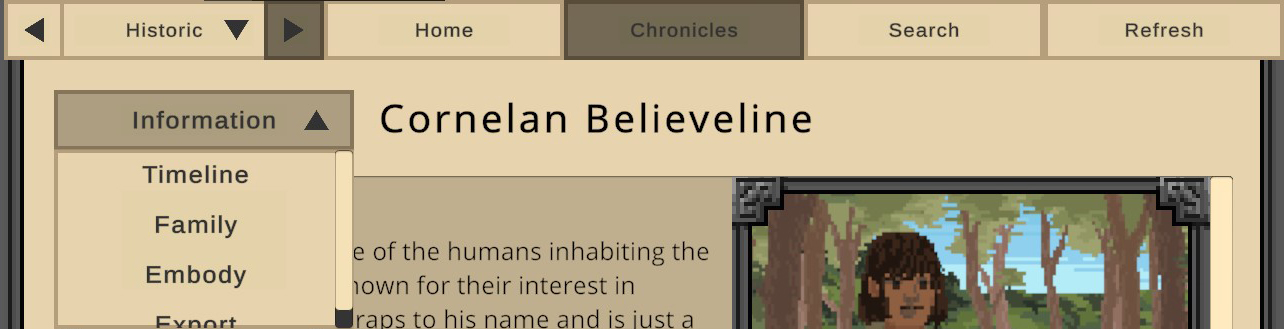
Chronicles V1
NAVIGATION
Header navigation
In Chronicles V1, the major pain point was the use of a dropdown menu for navigating the different tabs of each page; in Chronicles V2 we opted to use a simple but trusted header akin to a web page.
SEARCH
Search bar
The search feature was hidden behind a button leading to a search page, with the new interface players can simply type their search queries in an input field allowing them to stay on their current page.
BOOKMARK
Bookmark feature
Lastly, a requested feature was the ability to bookmark pages; the idea was that if players are going to move around between pages a bookmark would facilitate the navigation between relevant pages for them.

Chronicles V2
5. Chronicles V2 Evaluation
PLAYTESTS 2
A second round of playtests were done with mostly new participants; the goal was to confirm if the changes were going in the right direction
- A second playtest session replicated the initial setup, with participants completing a series of tasks in Chroniqueur for 30 minutes while I observed and took notes.
- Once participants were done with the playtest, they would take part in a semi-formal interview, allowing me to get a better understanding of their impressions with their experience.
- The playtest sessions yielded qualitative data, which helped us determine whether the changes were a step in the right direction.

PLAYTESTS 2 LEARNINGS
The redesign of the Chronicles was well received, the navigation is more intuitive, but some interactive affordances are less apparent
GOOD
A more intuitive interface
All participants had no problem navigating the interface, some even mentioned how it reminded them of a web page.
AMBIGUOUS
Potential overabundance of information
Some participants mentioned that certain information was superfluous.
BAD
Lost of interaction affordances
Certain interface elements lack clear affordances indicating that they can be interacted with.
6. Post-mortem
CHANGE OF DIRECTION
The goal of my research had to change because a significant hurdle of UI and UX would prevent a fair assessment and skew the results
- Initially the goal was to facilitate the discovery of stories in emergent narrative games, but in order for us to test with participants their ease of finding stories, we had to solve a problem beforehand.
- The problem was the interface’s usability; participants were struggling with the user interface (UI), which in turn made the user experience (UX) an obstacle for the discovery of stories.
- For this reason, I decided to change the direction of my research because it’s important to limit the number of outside factors that could influence the results.
ALWAYS LEARNING
My starting theoretical framework became less relevant after the pivot of my research, a new literature review about HCI would have been beneficial
- Most of my initial theoretical framework became less relevant for the research. I had read about game design, emergent narratives, and information design, because they were relevant to my opening research question.
- However, redesigning a UI and assessing its UX could have benefitted from invoking other Human-computer interaction (HCI) subfields. This is especially noticeable with the second playtest results, where most of the revisions made sense in hindsight, for they were common principles regarding UI and UX design.
- Another literature review focusing on UI and UX design should have been done before conducting the second playtests.
SAMPLE BIAS
Recruiting participants for the research proved to be difficult, this resulted in a small sample size which inadvertently impacted the results
- As with many research projects, participant recruitment proved challenging and may have introduced sample bias.
- The research ultimately involved 10 participants, which constitutes a relatively small sample.
- A larger and more diverse participant pool would have strengthened the playtest sessions and generated richer insights for Chroniqueur and its Chronicles.
7. Bibliography
- Beauchesne, Antoine. “The self-writing encyclopedia UI design for emergent story discovery.” Concordia University, Montreal, 2023.
- Ryan, James. “Curating simulated storyworlds.” University of California, Santa Cruz, 2018.
- Jenkins, Henry. “Game design as narrative architecture.” Computer 44, no. 3 (2004): 118-130.
- Kreminski, Max, and Noah Wardrip-Fruin. “Generative games as storytelling partners.” In Proceedings of the 14th International Conference on the Foundations of Digital Games, pp. 1-8. 2019.
- Nielsen, Jakob. “Ten usability heuristics.” 2005.
Portfolio
Info-Santé Navig
How might we redesign the 811 service model to handle high call volumes without overwhelming nursing staff or increasing wait times?
Braver Therapy Transfert
How might we design a sustainable approach to therapy transfer that fits real clinical workflows, supports families’ needs, and strengthens continuity of care across settings?